
From Field and Barn to Plate: Agroscope’s New Work Programme Places a Greater Focus on Impact and Practical Benefits
Bern, 20.01.2026 — Agroscope’s 2026-2029 Work Programme addresses the most important challenges facing the Swiss agriculture and food sector, and agricultural practitioners in particular. The focus is on six key issues to be addressed by the research institute in 42 research programmes and around 360 projects. Areas such as plant protection, plant breeding, climate-change adaptation and economic efficiency will be strengthened.
Safeguarding domestic food production, enabling farming families to earn a fair income and reducing the negative environmental impacts: these are important challenges facing the Swiss agriculture and food sector. With its new 2026-2029 Work Programme (WP), Agroscope aims to make a contribution to meeting these and further challenges, and to reducing the trade-offs of agricultural production.
Research from field and barn to plate and back
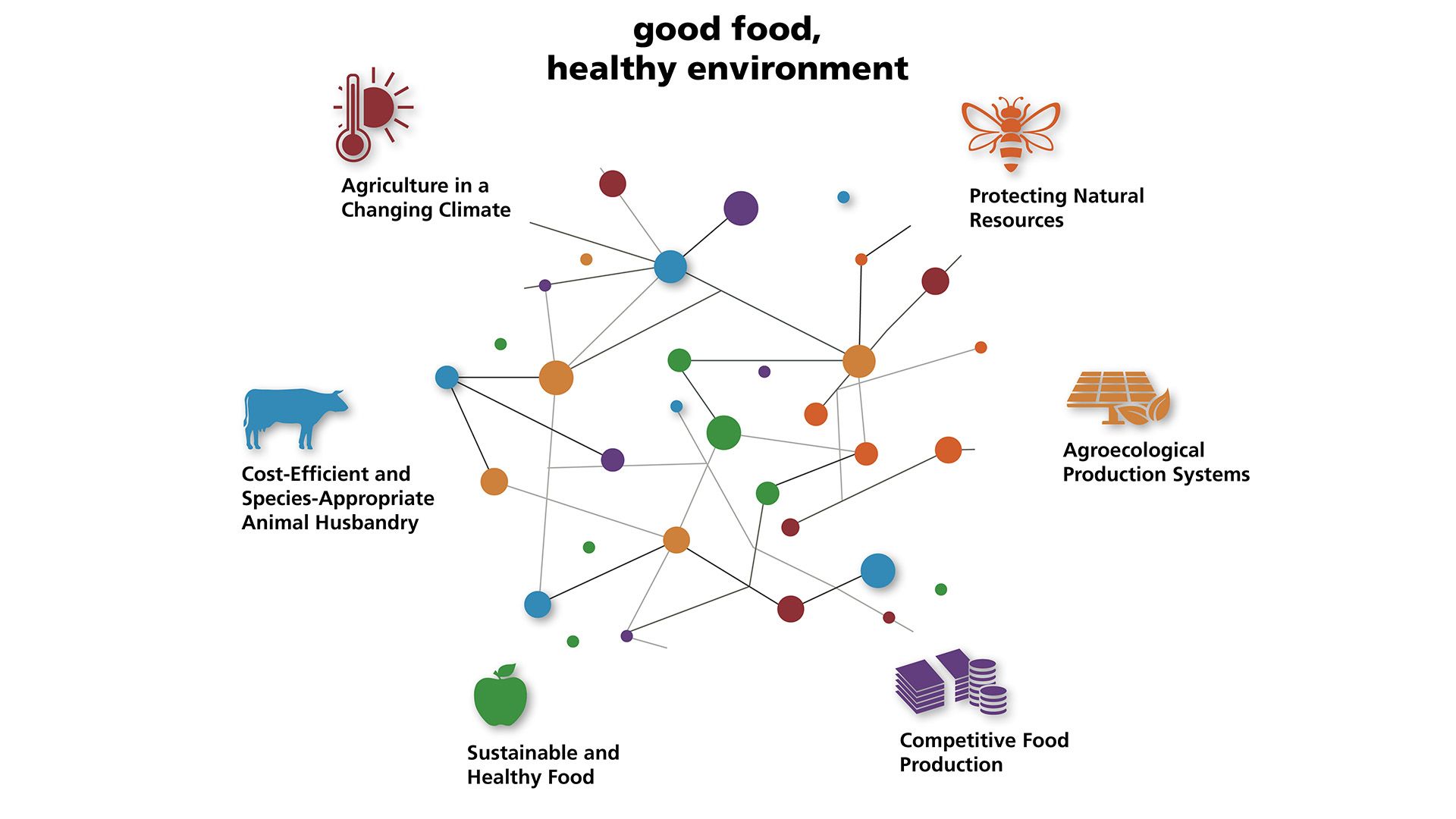
The new Work Programme continues to focus on six interlinked core themes: competitive food production, agriculture in a changing climate, protecting natural resources, agroecological production systems, cost-efficient and species-appropriate animal husbandry, and sustainable and healthy food. Agroscope conducts cross-disciplinary research across the entire agriculture and food sector on these focus areas. The aim is to develop solutions for increasing the ecological, economic and social sustainability of the agriculture and food system.
Novel developments vis-à-vis the last Work Programme
Agroscope is strengthening research in the areas facing major challenges, such as climate-change adaptation, water efficiency, crop protection, particularly in vegetable and field crops, sustainable livestock production and reduction of nutrient losses. Since the aim is to improve the social and economic sustainability of agricultural production for farming families, research into cost-efficiency and value creation is also being expanded. The Swiss Parliament has also allocated additional funds for plant protection and plant breeding, which strengthens these particularly challenging subject areas with additional research projects.
Focus on impact and practical benefits
The motto ‘We research with and for farmers’ gains even greater importance in the new Work Programme. More systematically than before, the WP is designed for the benefit of and its impact on agricultural practice, without neglecting the basic research that is necessary for this. Each of the 42 research programmes addresses a specific topic as well as defining goals and expected impacts. The practical relevance of the projects and knowledge transfer are ensured by the strong involvement of stakeholders from agricultural practice, the Federal Administration, the agricultural extension and the Cantons.
Comprehensive assessment of needs
The Work Programme was developed via a structured process involving many sectors, associations, organisations and stakeholder groups within the agriculture and food sector. Around 70 organisations submitted over 650 proposals which were prioritised jointly. In addition, Agroscope took into account overarching strategies of the Swiss Federal Council, future visions for the agriculture and food sector, and changing social requirements.
The content of the new Work Programme has been positively received and supported by Agroscope Council. This advisory body is composed of representatives from the Federal Administration, science and agricultural practice.
More about “From Field and Barn to Plate: Agroscope’s New Work Programme Places a Greater Focus on Impact and Practical Benefits”
Video: “Agroscope Presents its 2026–2029 Work Programme” (show English subtitles under settings)
Agroscope Work Programme 2026-2029