
Polymer cables for MRI applications: No place for metal
St. Gallen, 20.01.2026 — Anyone who has ever had to get a magnetic resonance imaging (MRI) scan knows that magnetic and highly conductive materials are a no-go in the tube-shaped scanners. However, for complex diagnoses and medical research, this imaging technique often needs to be combined with other methods that require conductive cables. As part of an Innosuisse project with the Swiss company TI Solutions, researchers at Empa have developed polymer-based cables that function safely and reliably in MRI machines.
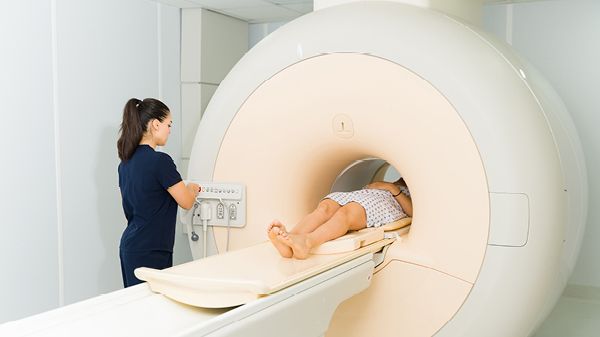
Magnetic resonance imaging, MRI for short, is a powerful imaging technique in medicine. It can be used to produce high-resolution images of tissues and organs that reveal even the tiniest injuries, sites of inflammation and early-stage tumors. The procedure uses radio waves and extremely strong magnetic fields. Metal is therefore problematic inside an MRI: Unless they are specially designed, metallic objects such as implants can heat up and cause burns – even if they are not directly attracted by the magnetic field.
MRI can also be combined with other diagnostic and therapeutic procedures, such as electrical examinations of the heart (electrocardiogram, ECG) and the brain (electroencephalogram, EEG), or stimulation of deep brain structures using temporal interference stimulation (TI). To do this, the patient must wear additional electrodes on their chest or head while inside the MRI scanner. And this is precisely where the combined methods reach their limits: The electrodes must be connected to a measuring device by cable, and cables are usually made of copper. In the MRI scanner, they can heat up – plus, they interfere with the MRI imaging.
Researchers from Empa's Advanced Fibers laboratory in St. Gallen have developed a surprising solution in collaboration with their industrial partner TI Solutions AG. Their electrode cables are not made of copper, but of plastic – at least for the most part. Instead of metal wires, researchers led by Dirk Hegemann have used bundles of polymer fibers coated with only a thin layer of metal.
“Our goal was to develop a cable with a very low but precisely defined metallic conductivity,” says Hegemann. “The conductivity must be high enough for the signal to be transmitted, but not as high as to interact with radio waves.” TI Solutions, a company that develops electrodes for stimulating and measuring brain waves, specializes in brain stimulation using TI and EEG – thus a perfect match for the collaboration, which took place as part of an Innosuisse project. “With ‘MRIComplead’, the MRI-compatible cables developed in the Empa lab, our medical research partners now have the opportunity for the first time to visualize the effect of TI in the brain using MRI safely and without interference,” says Sven Kühn, Head of Research and Development at TI Solutions.
Robust and scalable
The predefined electrical conductivity is just one of the requirements that the polymer cables had to meet. In order to be usable in medicine and research, they also had to be durable and resistant over an extended period of time, both to corrosion of the coating and to the mechanical stresses that arise, for example, when plugging and unplugging the cables.
The researchers tested around a dozen coatings using different materials and coating techniques. A thin film made of silver and titanium proved to be the winner. “Silver has very good electrical conductivity,” explains Hegemann. “Titanium reduces the conductivity somewhat so that we can achieve our specified range.” The two metals also stabilize each other against corrosion. The researchers have already tested the first coated plastic cables for a year and demonstrated that the conductivity has hardly changed over this period.
The researchers applied the ultra-thin coating, which is less than half a micrometer thick, to the fiber using magnetron sputtering: an established process that can be used in an industrially scalable roll-to-roll process. The Empa team has already produced around one kilometer of coated fibers for the first cables. The Innosuisse project was successfully completed in 2025. Nevertheless, the partners remain in contact. “We continue to support our industry partner when it comes to demonstrators and initial sampling,” says Hegemann. “Empa's efficient and uncomplicated support in the pilot series phase is another benefit of our collaboration,” says Niels Kuster, President of TI Solutions AG. If the polymer cables prove themselves in these initial applications, they will go into industrial production.
Further Informations
Dr. Dirk Hegemann
Empa, Advanced Fibers
Phone +41 58 765 72 68
dirk.hegemann@empa.ch